
Flooring Restoration Los Angeles: The Complex Reality of Water or Fire Damage
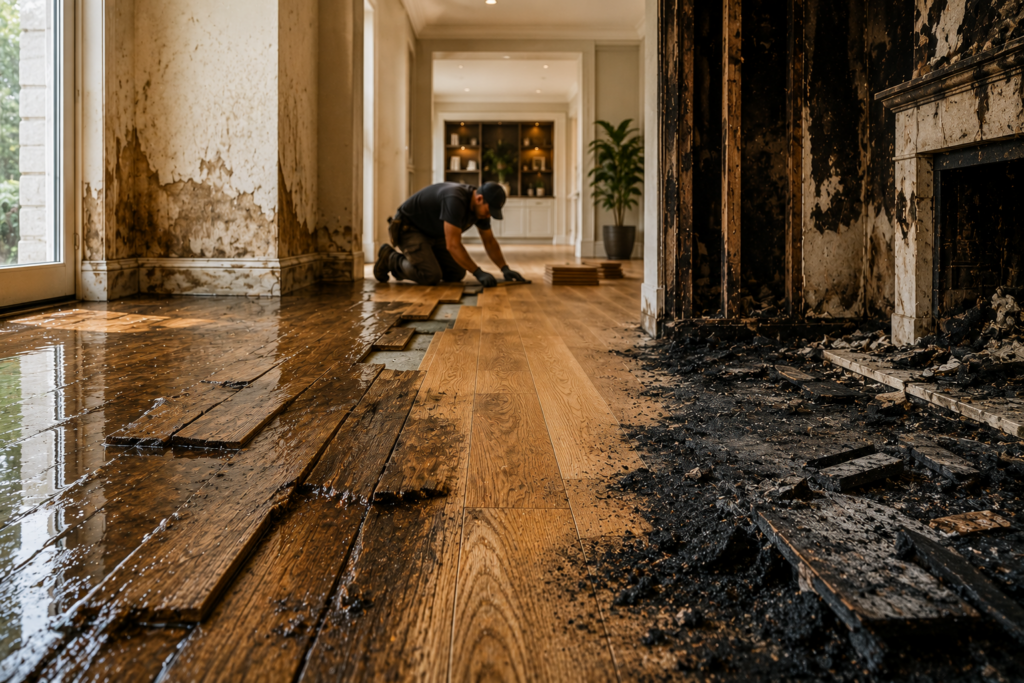
Restoring hardwood flooring after water or fire damage in Los Angeles is often misunderstood as a simple replacement task. In reality, it is a technically demanding process that requires informed judgment, experience, and a deep understanding of how damage behaves beneath the surface, particularly in Southern California’s climate. What homeowners see immediately after an incident rarely reflects the full extent of the problem. Effective restoration depends not on cosmetic fixes, but on identifying and resolving the hidden conditions that determine long-term performance.
How Los Angeles Climate Conditions Affect Flooring Restoration Outcomes
Homes in Los Angeles face unique restoration challenges due to fluctuating humidity levels, coastal moisture, hillside construction, and slab-on-grade foundations common throughout the region. These factors significantly influence drying timelines, subfloor behavior, and long-term flooring performance, making localized expertise essential in water and fire damage restoration.
Why Visible Damage Tells Only Part of the Story
Surface-level damage, such as warped boards, discoloration, or soot residue, is typically the most noticeable sign of a problem. However, the most consequential damage frequently occurs below the finished flooring. Moisture can migrate into subfloors, insulation, and structural framing, while smoke particles embed themselves into porous materials. Although these issues may not be immediately visible, they can significantly compromise the integrity of the flooring system over time.
A restoration strategy based solely on what can be seen almost always fails to address the full scope of damage. Successful flooring restoration begins with a comprehensive evaluation of what lies beneath the surface, not just what appears damaged at first glance.
Flooring Restoration Los Angeles: Subfloor Conditions Drive Restoration Outcomes
The condition of the subfloor is the single most critical factor in determining whether hardwood flooring can be salvaged or must be replaced. After water or fire damage, subfloors must be evaluated for moisture infiltration, structural movement, microbial growth, and smoke absorption. Even small amounts of residual moisture can destabilize an otherwise intact hardwood floor months after repairs appear complete.
In many cases, drying only the visible flooring is insufficient. Moisture trapped below the surface can reintroduce problems long after an insurance claim has been closed. Restoration decisions that overlook subfloor conditions often result in recurring failures that are costly, disruptive, and preventable.
Drying Does Not Always Mean Saving the Floor
One of the most common misconceptions in water and fire damage restoration is the assumption that if a floor can be dried, it can be saved. While drying is a critical component of remediation, it does not guarantee long-term performance. Wood responds differently to moisture depending on species, cut, thickness, installation method, and environmental conditions.
Some hardwood floors may regain dimensional stability after controlled drying, while others experience permanent structural changes that compromise performance. Attempting to preserve flooring that has exceeded its tolerance thresholds frequently leads to delayed failures such as cupping, joint separation, or surface irregularities. Knowing when drying is appropriate, and when replacement is the responsible option, requires professional experience, not guesswork.
Species Sensitivity and Construction Methods Matter
Not all hardwood flooring reacts equally to water or fire exposure. Certain species are more dimensionally stable, while others are highly sensitive to moisture fluctuation. Engineered flooring behaves differently than solid wood, and installation methods, such as glue-down versus nail-down systems, further influence restoration viability.
Applying a one-size-fits-all approach to flooring restoration ignores these variables and increases the risk of failure. Effective restoration is not based on preference; it is based on compatibility between materials, damage conditions, and long-term environmental behavior.
Specialized Equipment and Ongoing Monitoring Are Essential
Proper flooring restoration requires more than air movement and surface drying. Specialized equipment—such as moisture meters, thermal imaging tools, and controlled drying systems—is necessary to track conditions over time and confirm that materials have reached safe equilibrium levels.
Equally important is ongoing monitoring. Moisture conditions can change as drying progresses, and premature conclusions often result in incomplete remediation. Experienced restoration professionals rely on data-driven assessments rather than visual assumptions to determine when a structure is truly ready for repair or reinstallation.
Insurance Guidelines Shape Technical Decisions
Flooring restoration after water or fire damage does not occur in isolation. Insurance guidelines influence scope, sequencing, and documentation requirements throughout the process. Restoration decisions must balance technical best practices with policy constraints, coverage determinations, and causation analysis.
Professionals experienced in insurance-related restoration understand how to align remediation strategies with insurer expectations while still protecting the homeowner’s long-term interests. This includes justifying replacement when salvage would compromise performance and documenting conditions thoroughly enough to support those determinations.
Why Experience Determines the Right Outcome
At its core, hardwood flooring restoration is a judgment-driven discipline. No two damage scenarios are identical, and rigid formulas rarely apply. The difference between a successful restoration and a recurring failure often comes down to experience, recognizing patterns, understanding material behavior, and anticipating long-term consequences.
Restoration decisions made without this expertise frequently prioritize short-term savings over durability, leaving homeowners with unresolved issues long after the initial repair appears complete. A properly restored floor is not simply repaired; it is stabilized, validated, and prepared to perform reliably for years to come.
Conclusion: Restoration Is a Technical Discipline, Not a Cosmetic Repair
Flooring restoration after water or fire damage extends far beyond replacing damaged boards. It is a technical discipline that requires comprehensive evaluation, specialized tools, material knowledge, and informed judgment. When handled correctly, restoration preserves not only the appearance of a home but also its structural integrity and long-term value.
For homeowners in Los Angeles, this process demands an additional layer of localized expertise. Climate conditions, construction methods common to the region, and insurance requirements all influence restoration outcomes. Working with professionals who understand both restoration science and the realities of Los Angeles homes allows property owners to make confident, well-informed decisions at a critical moment.
The right choices made early in the process reduce long-term risk, protect the investment, and determine whether a floor merely appears repaired or truly performs as intended for years to come.