
What Have You Done To My Floors?
The “power of professionalism” wins the trust of others, as it promotes the contractor and his company by clearly respecting others. It also fulfills the reality that the contractor embraces improving the lives of others.
But what do you do when, as a homeowner, you are NOT fortunate enough to find that PROFESSIONAL?
As sad and aggravating as it may sound, it’s the harsh reality. There are numerous mistakes that homeowners make when hiring a flooring contractor. These mistakes include: not knowing which products should be used, and, not hiring a competent flooring contractor. Because of these mistakes, thousands of dollars are lost due to these poorly educated decisions about the professionals they hire and end up spending money on the wrong person/company, including fixing these costly mistakes the contractor caused.

High-quality flooring installations can be challenging even for the most experienced professionals. As each material can pose an obstacle in its own way, mishandling these issues can trap a flooring contractor into attempting a cosmetic cover-up, or, warrant a return call to address a quality issue.
Be honest with yourself, have you ever thought about why one contractor is way less expensive than another contractor? Did it ever occur to you why an unlicensed contractor is less expensive than another contractor who is licensed, bonded, and carries liability insurance?
The only way a contractor can quote so cheaply is if they minimize the expenses. That’s what leads to a low-quality installation. As flooring professionals, they must consider all aspects of the flooring installation to ensure that the project is performed perfectly. One should always consider a contractor that implements fair pricing and provides high-quality installations.
Olde Tyme Floor advises you NOT to believe the catchphrase: “everyone learns from their mistakes”.
Learning from others is important, especially if we are talking in terms of such a huge investment as hardwood flooring. Analyzing others’ problems gives you an opportunity to save money, and most importantly AGGRAVATION!
As you might have guessed from the title of this article, today’s topic is regarding an inspection case that absolutely shocked us. So, in turn, we would like to educate you so that you’ll never make this mistake and approach the choice of hiring a quality contractor that will know how to help you with your hardwood flooring project.
Let’s see what the contractor’s inexperience has led to this time.
In August 2019, a homeowner had engineered hardwood floors installed at their home in Palmdale, California. The manufacturer described the floors that were installed as “Curupay Teak”, which contained a dark surface that evoked pleasing contrasts against the home’s lighter-colored walls.
However, a little over three months after installation, the homeowner noticed that something was NOT right with their new purchase. They noticed that some of the boards on the 2nd floor were cupped and warping.
Later, they would learn the proper term for this condition: “dry cupping”.
The National Wood Flooring Association (NWFA) defines “dry cupping” as “a concave or dished appearance of individually engineered flooring planks where the edges are raised higher than the center.”
Rightfully distraught, the homeowner contacted the original installer, who then dispatched a crew “post-haste” to address the problem. The team went upstairs, replaced the damaged boards, and assured their customer that everything would be fine from now on.
Except…everything was not fine!
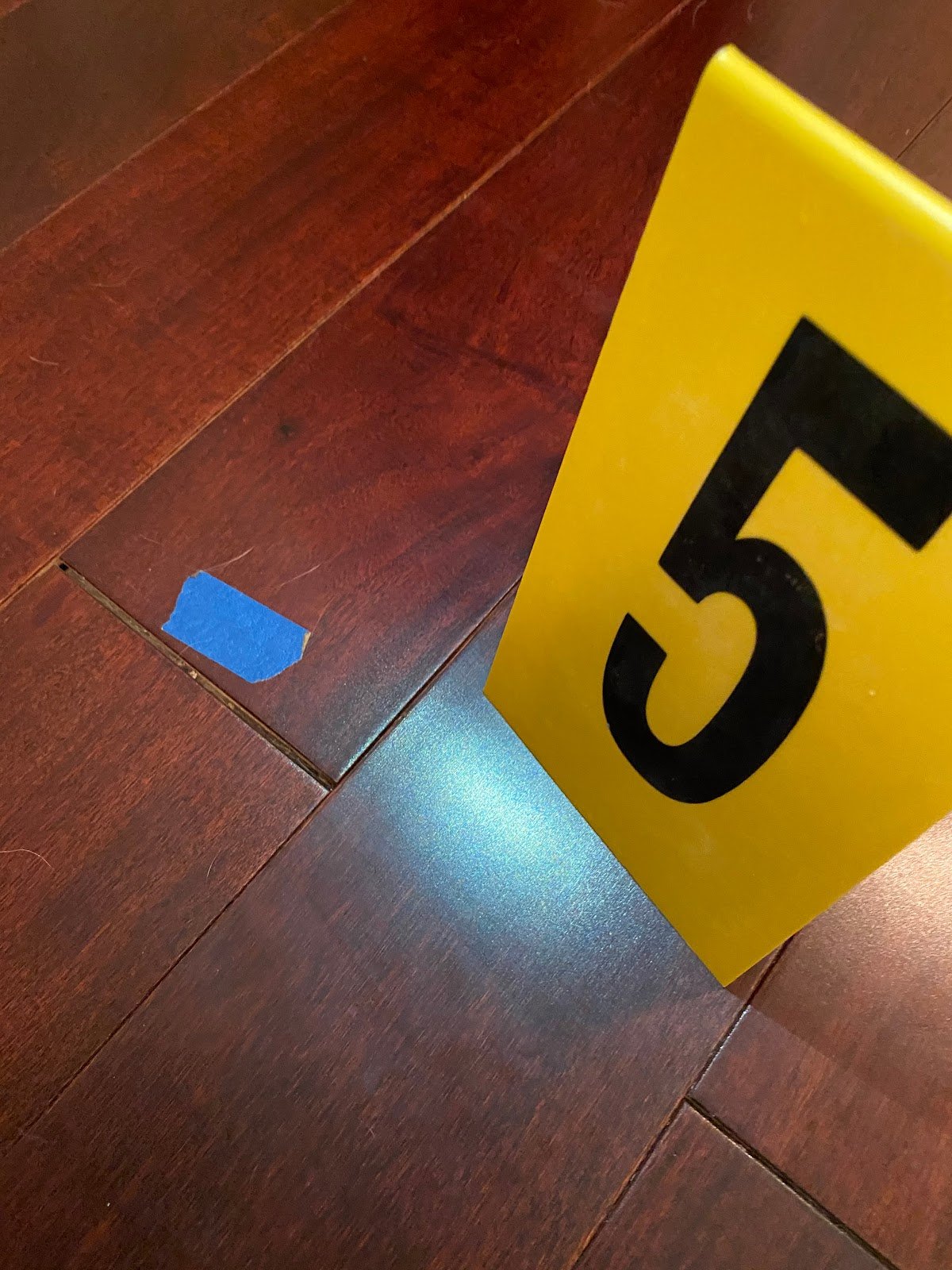
Several of the boards now had unsightly gaps at the butt-ends between them. Others were cracked. Looking at the floors, the homeowner could not help but suspect that the installation had not been conducted properly.
Consequently, in August 2020, they contacted an NWFA-certified flooring inspector and explained what was going on. Within the month, the inspector paid a visit to the residence and conducted a detailed analysis of the 2nd level floors.
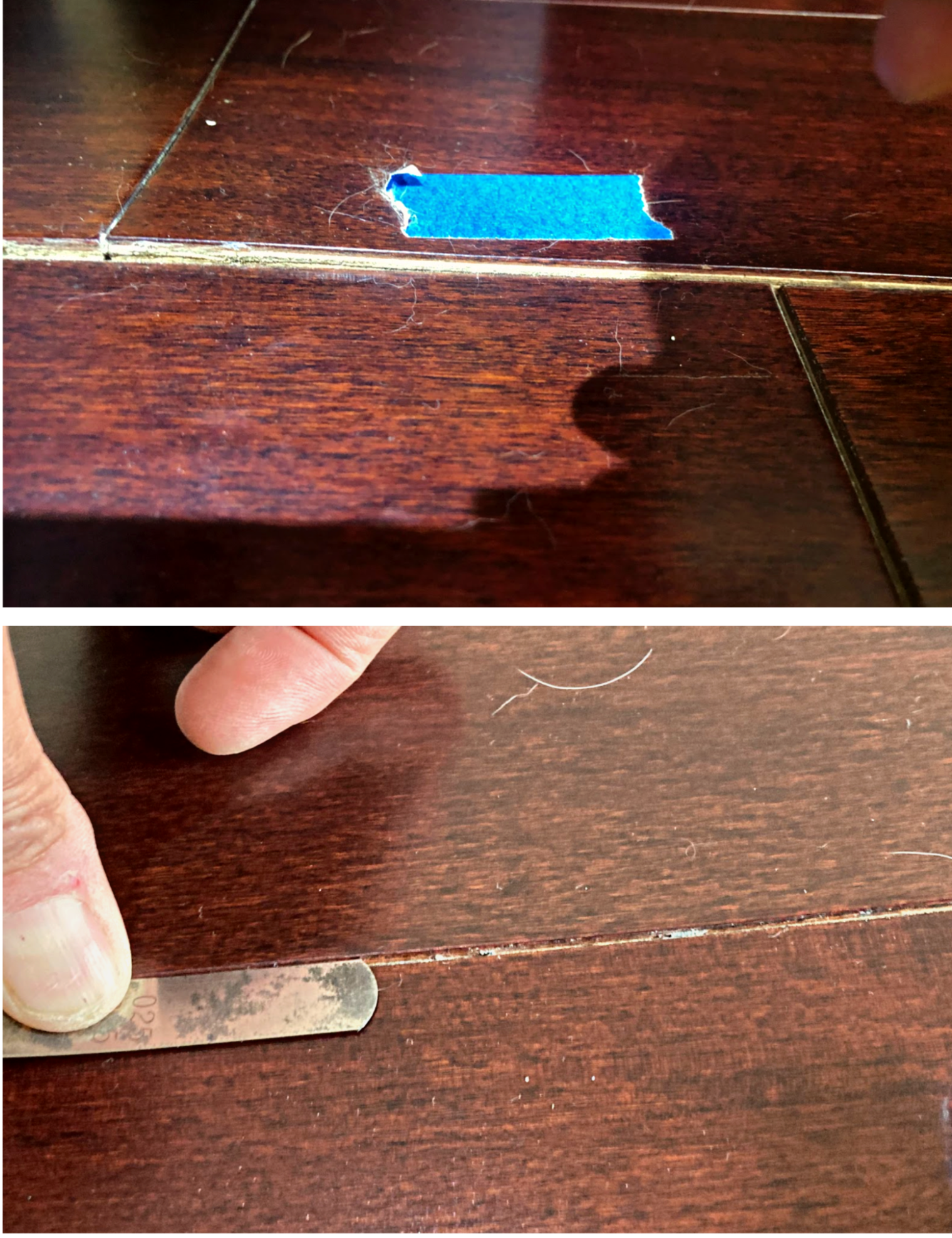
This included the use of a feeler gauge that measures the gaps at the end-joints of the floor-boards. Some of the gaps were wide enough to take three blades of .026″, .010″, and .012″, resulting in a total gap of .048″. Other gaps measured at .025″ and .062″.
Please look at some of the photos from the inspection to see the damage with your own eyes. These images show where the installers left significant gaps in the end-joints. Adjacent boards are intended to be snugly fitted together, and these gaps are definitely outside the manufacturer’s installation guidelines.
As mentioned above, some of the gaps were wide enough to take three blades of .026″, .010″, and .012″, resulting in a total gap of .048″. Other gaps measured at .025″ and .062″ wide.
These measurements raised serious concerns with the inspector about the installation procedure and product quality. The inspector had an attorney contact the factory including the installer. The attorney discovered that indeed, these two parties had been arguing about the product’s quality beforehand. Not only that but parts of the product came damaged out of the box. The damaged parts were discarded, but the fact of their existence was troubling.
It should be noted the inspector was also able to determine that on the day of the installation, the job site temperature including the relative humidity (RH) was NOT in alliance with the manufacturer’s specifications. The manufacturer’s specifications stated that:
- The temperature MUST be between 60-80 degrees Fahrenheit.
- The RH (relative humidity) MUST stay between 35%-55%.
Instead, these were the following conditions on the day of installation:
- The temperature was 92.3 degrees Fahrenheit.
- The RH (relative humidity) was only 26.5%.
Due to the above findings, the homeowner was successful and was able to have their flooring removed & replaced. The California Song-Beverly Act of 1970 was established for buyers of consumer goods that have been damaged by a failure to comply with the obligations stated in that act, including compensation for the following:
- Damages.
- Equitable relief.
- Civil penalties.
- Recovery of litigation costs and expenses, including attorneys’ fees.
Because parts of the product were damaged out of the box, the manufacturer was deemed responsible for replacing the floor.
At the end of the day, it’s important to realize that hiring a reliable Hardwood Flooring Contractor, will help guarantee that your floors are in good shape and properly installed. While quality workmanship may seem more costly upfront, in the long run, it’s actually less expensive and aggravating.
If, however, it’s too late, you still may be able to have your floors repaired by an accountable party like Olde Tyme Floor Company!
Save yourself time, money, and stress!
Fill out the form now to receive a FREE online quote so we can help you with your hardwood floor installation.