
What Is The Most Durable Wood Flooring?
If you’ve decided to invest in wood flooring for your home, it’s a foregone conclusion you’re going to expect some longevity. It also makes sense to envision trouble-free maintenance, and performance that makes you feel good about the purchase every time you walk on it. Indeed, hardwood floors carry a reputation for lifespan and beauty. It’s only logical to expect greatness. But what exactly constitutes the best of the best? Which kind of hardwood flooring should you choose for strength against traffic, pets, climate, and any number of other encroaching hazards? Funny you should ask (you did ask, right?), because today we’re going to examine different kinds of durable wood flooring.
Oak
A lot of you reading knew this one was going to be first. Not only do oak hardwood floors look amazing, with their yellow-brown hue, in just about any room of the house, they can also do their job for over one hundred years. A big reason oak is so durable has to do with its density. An oak tree can live for a thousand years. Stop and think about that before you just nod your head and read on. There are oak trees born in early medieval England that could still be alive today. This is a tough, reliable material for your floors.
You can also snatch it up at a great price—about $2 per square foot. You can finish oak flooring with hard wax oil to protect it even further without sacrificing its natural appearance. Clean these floors with a daily sweep, and when it’s time to mop, make sure the soap you use works well with your chosen finish. Or, if you’ve decided to leave the oak bare, it can be mopped with a mixture of 1/2 cup of vinegar per 1 gallon of water.
Hickory
Oak still not tough enough for you? Consider hickory. Whereas oak ranks about 1400 on the Janka Hardness Scale, hickory scores closer to 2000. Hickory is a light-colored wood fraught with alluring grains and streaks. For this reason, many customers choose wider planks to really show off their style.
The material can be purchased for around $5 per square foot. Cleaning is normally simple as spraying the floor with a proper cleaner, followed up by a mopping. Polyurethane is a popular finish for hickory, albeit to do the job properly will take a couple of days. Up to five coats of finish can be added. Don’t forget to sand between every coat.
Brazilian Cherry

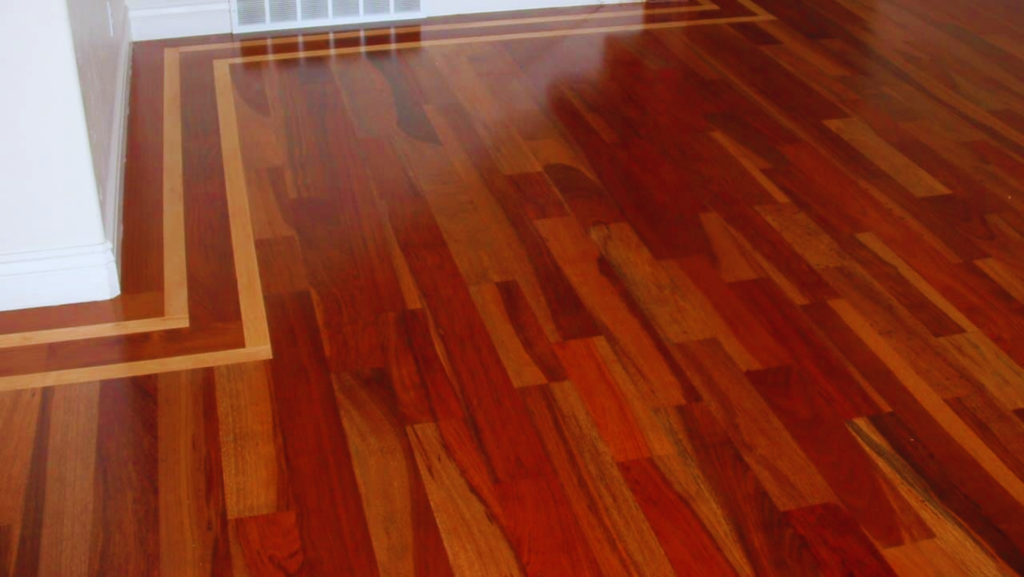
Moving on to stronger wood still, we have Brazilian cherry. Ranking around 2350 on the Janka scale, this is the first exotic hardwood on the list—meaning, it isn’t grown in the United States. Brazilian cherry looks just like how it sounds: It has a reddish color that gets more and more rich with exposure to sunlight. If one stares for long enough, this is wood pretty enough t get lost in. Be careful, Alice.
Because it looks so nice—and because it’s imported—the cost goes up, though not much. Expect to pay between $5 and $6 per square foot. Cleaning is also a breeze. A few drops of dish soap in a bucket of warm water normally does the trick. Take care not to go over the floor with a saturated mop—i.e. wring it out good before each use. Do you need to stain Brazilian cherry? No. It’s dark and rich enough on its own; in fact, you may find yourself moving the furniture around quite a bit to keep up with ongoing hue change caused by sunlight (the floor won’t change color under the chair, or the couch).
Brazilian Walnut
Now let’s move on to perhaps the very strongest wood we know. Brazilian walnut, also known as IPE, scores a whopping 3680 on the Janka hardness test. This stuff is quite literally tough as concrete and steel. In fact to install it, contractors often need to drill holes for the insertion of steel screws. With that added labor, this could increase the cost of IPE from $5 per square foot to close to $20 per square foot. IPE is typically a dark brown shade, shot with black grain, making it a handsome choice for rooms where you like to relax. And because it’s resistant to termites and rot, many consumers call it the go-to choice for decking.
Finishing an IPE surface can be tricky. The material’s density makes it difficult for oil to penetrate. That being said, there are products on the market that can handle the job. Cleaning can be done with basic daily sweeping, a mop, and some water.
Shown are just a few of the most durable hardwoods you can choose for your floors. If you’re looking for several decades of service from your investment, it’s certainly possible to do worse than the above mentioned. Hardwood floors make a handsome, powerful enhancement for any home that gets them. And now you know about some of the strongest available.