
Installation Methods
There are certain types of wood floors that require delicate, meticulous installation. For perfect performance, they must first be in alignment with acceptable jobsite conditions. The installer should also follow acclimation standards recommended for the material. He/she needs to consider the grade level of the floor’s location, as well as the guidelines for subflooring, which differ depending on whether it’s made of wood or concrete. All of these are important, along with other installation methods that might be specific to the material being used. The road to completion could be tricky and fraught with peril, but as many hardwood floor owners would doubtless testify, the risks are worth the reward.

Solid Wood Flooring
Solid wood floors, be they of strips or planks, will not be attached to a backing. As the name tells us, the boards are solid all the way through. The wider planks are considered to be more valuable than narrow strips, as they are more durable and more difficult (rare) to obtain. To achieve the best results from either, the guidelines are similar. Let’s begin by examining the minimum jobsite requirements for solid wood flooring installation.
They go as follows:
- Moisture outside the building should drain away, or downhill
- The flooring may also need protection from an appropriate vapor retarder
- These vapor retarders differ depending on the material used for your subflooring system
- The jobsite must be enclosed before wood flooring is delivered
- If HVAC is present, it needs to be turned on before, during, and after installation
- Flooring must not be delivered to the jobsite until the proper temperature and humidity conditions have been achieved
- Flooring must not be delivered before all concrete, masonry, plastering, drywall, texturing and painting primer coats are completed
- Basement and crawl spaces need to be dry
- Crawl space can be no less than 18” from ground to the underbelly of the joists
- Crawl space should be covered by a proper, puncture-resistant membrane
Acclimation is better known in the business as conditioning. The National Wood Flooring Association defines it as the process of adjusting the moisture content of wood flooring to the environment in which it is expected to perform. The MC of stripwood should not exceed 4 percent the MC of the subfloor. For planks, the margin of error is 2 percent. Some other important conditioning guidelines include:
- The allowance of 3 days for conditioning
- The MC (moisture content) of the product and air around it should be balanced as possible
- Unbox your shipment of wood, then separate the pieces to allow for better air exposure
- Protect flooring warranties by not deviating from manufacturer recommendations
Installing solid strip or plank wood flooring at the proper grade level is also imperative. An easy way to remember this part is: Even or above.
Do not install this kind of wood flooring below grade level. The NWFA defines below grade level as where soil is present along any perimeter wall and is more than 3" above the installed wood flooring level.
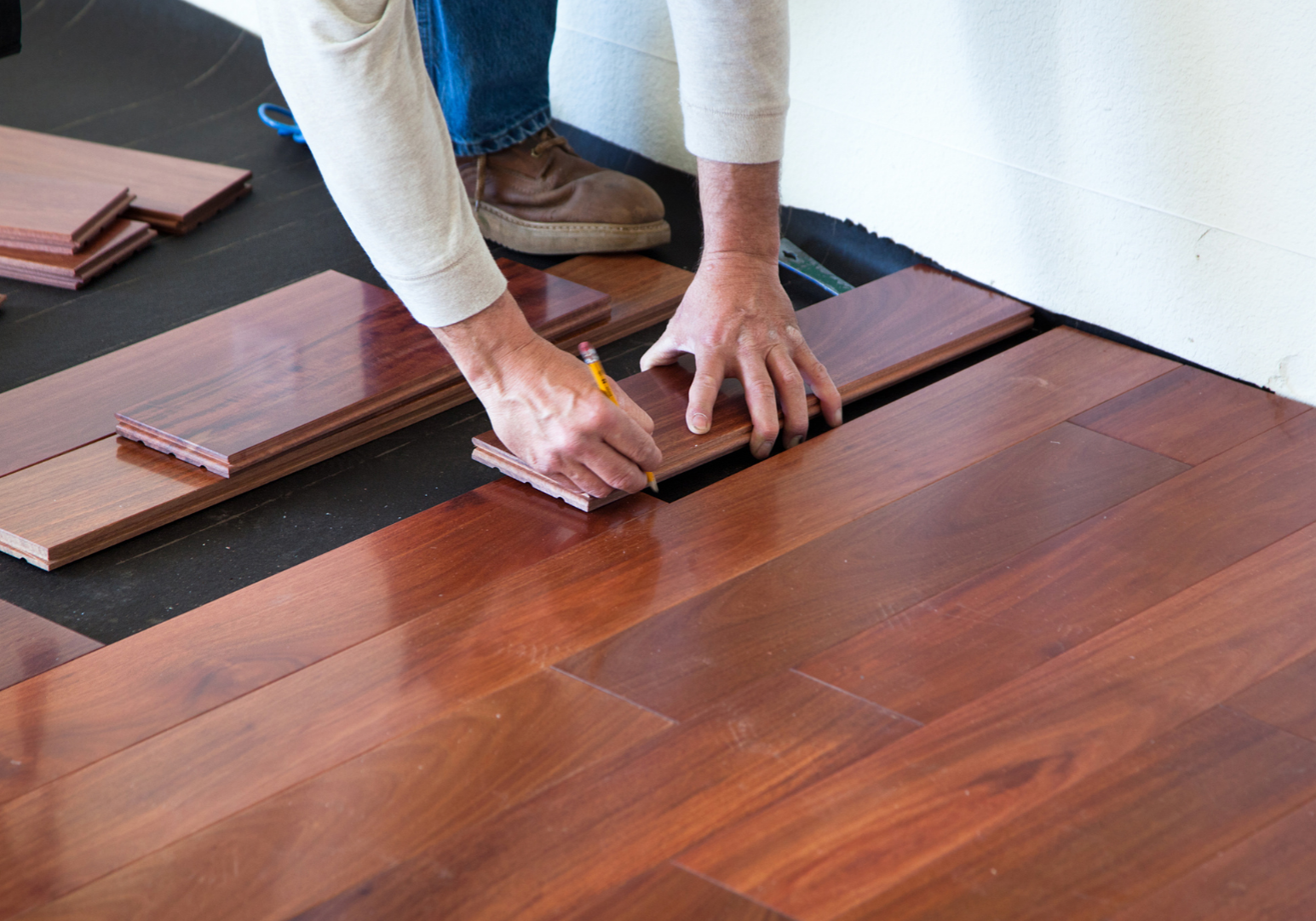
Wood subflooring should meet NWFA specifications for thickness, moisture content, and flatness. It must be clean, dry, durable, and silent. These same specifications apply for concrete subflooring. The slab must not be chalky, cracked, or soft. High spots can often be ground flat, while depressions may be filled in with appropriate patching compounds.
Strip and plank flooring is normally installed at a 90 degree angle to the joists, or diagonally if the subfloor is single layer. To slow down moisture flow at the jobsite, use a vapor retarder prior to installation.


Engineered Wood Flooring
Engineered wood flooring consists of a layer of real wood attached to a quality plywood substrate. Its planks can be the same width as solid wood planks or ever wider. As for installation methods, many of the same guidelines apply. Proper jobsite requirements, conditioning, grade level, and subflooring standards play a tremendous role in engineered wood’s performance. If you plan on using a concrete subfloor, engineered wood is probably the better choice, as its plywood construction tends to hold up better in humid conditions, and is less likely to warp.
Solid hardwood is typically installed by tongue and groove, then nailed to the subfloor. This is also possible with engineered wood, but more often, the planks fit together using a simple “click and lock” mechanism which then “floats” on the subfloor with no further anchorage. For this reason alone many DIY’ers prefer their wood floors to be engineered.

Laminate Flooring
This is a man-made, multi-layer structure composed of a photographic application protected by clear coating. Its central layers are normally melamine resin and fiber board. Laminate is hugely popular for its budget price and friendly maintenance procedures.
Like solid wood, laminate flooring often uses a snap and click locking system. Many DIY’ers prefer to let it float over a subfloor of foam material, which makes the planks more quiet to walk on. A 5 millimeter gap should be left between the floor and immovable objects such as walls. This will allow the installation to expand and contract with changing room temperatures.
Installation preparation should go as follows:
- Condition the flooring for at least 48 hours before installation
- Check the subfloor moisture level and see that it meets manufacturer standards
- Make sure you’re installing on an even, level plane
- Make sure to have enough space for doors to open/close once the laminate floor is installed
- If your subfloor is prone to moisture, lay a moisture barrier over-top

Luxury Vinyl Flooring
Luxury Vinyl is made with 6-8 layers of synthetic material, with the vinyl layer printed to resemble—in this case—wood. Other layers include a clear top-coating, a wear layer for protection, and a cushion layer for walking comfort. This is a waterproof floor, but don’t get too complacent with that feature, as it’s still possible for moisture to seep between the tiles or planks and attack the substrate.
Luxury vinyl floors use a click-lock system that floats without the use of glue or nails. Installation preparation goes as follows:
Condition these floors for at least 48 hours before installing
Make sure the surface is clean, flat, and dry
Base and island furniture needs to be placed first; do not install heavy objects on top of the vinyl
Make sure that doors will be able to swing without scraping the vinyl
The style of floor for your home is not a choice to be made lightly. You need the right look, the right feel, and of course, optimum performance. Approaching wood floor installation with knowledge is imperative for achieving the desired results. This is one reason the NWFA provides us with so many installation guidelines. But when they all come together in your living room, hallway, or anywhere else you want wood flooring, the perfection is almost palpable. And so too will be your happiness at a job well done.