
Failures of Adhesion on Bonded Hardwood Flooring
Adhesion failures can occur in many ways, each of which is avoidable if good practices are followed. However, in real life, NOT all flooring installers follow the NWFA (National Wood Flooring Association) instructions and guidelines, which leads to serious and highly costly flooring issues which are precisely what happened to this homeowner.
So, using data from the inspection of this case, we would like to tell you more about the failures of adhesion.
According to the homeowner, the Artisan Hardwood Flooring (Engineered Birch) was installed approximately four years ago.
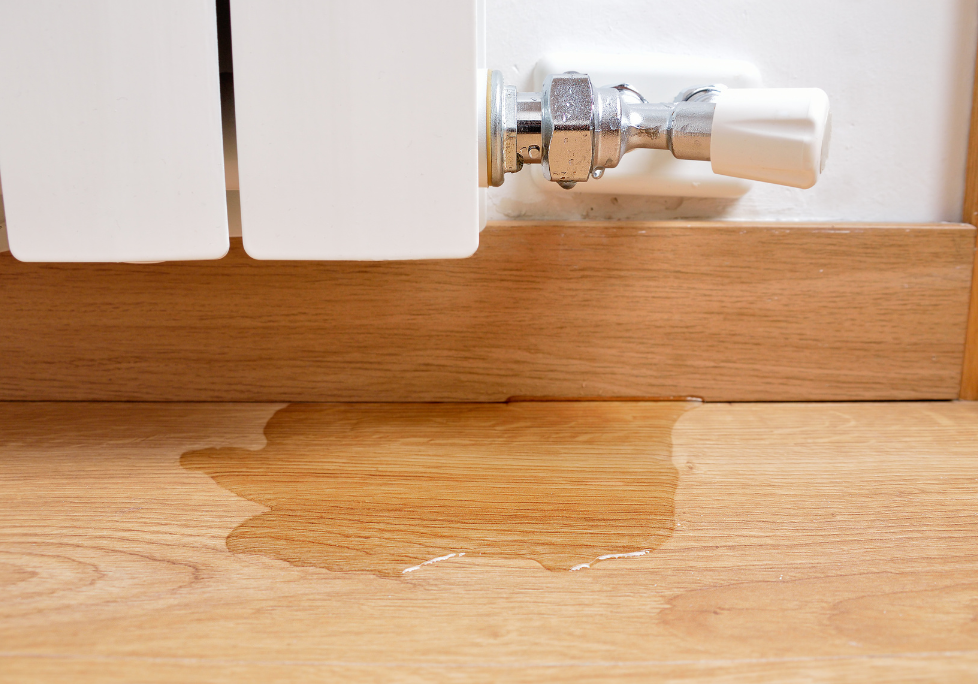
Six months after the floor was installed, they contacted the retailer, indicating that there were problems with the floor installation. (Consequently, the flooring was replaced due to water damage, so all the expenses were covered by the insurance).
And, with most cases nowadays, when homeowners do NOT use licensed contractors or use inferior flooring products, or, when they do not follow NWFA rules and guidelines, trouble starts to happen to the flooring...
In this case, the initial issues surfaced in the hallway shortly after the job was completed, and the installer immediately returned and repaired it without any investigation. That being stated, the current issues started to manifest in early 2021:
The failure of the two-part adhesive used, resulted in “hollowing” and prominent discoloration in large sections of the flooring. The installer who caused these issues completely ignored the correct rules of applying the adhesive during the installation and was only willing to repair it at the homeowner's cost! Furthermore, the installer denied any wrongdoing by providing no actual evidence that his job was done correctly.
Is it fair to pay for someone else's mistakes? Of course not!
In today's realities, it’s well known in the flooring industry that unlicensed installers who perform their job poorly, want to cash in on you.
In looking at the photos below, this case is to make sure that ONLY licensed and experienced flooring contractors should be trusted with flooring work…
Adhesion failures can occur in many ways, each of which is avoidable if good practices are followed. However, in real life, NOT all flooring installers follow the NWFA (National Wood Flooring Association) instructions and guidelines, which leads to serious and highly costly flooring issues which are precisely what happened to this homeowner.
So, using data from the inspection of this case, we would like to tell you more about the failures of adhesion.
According to the homeowner, the Artisan Hardwood Flooring (Engineered Birch) was installed approximately four years ago.
PHOTO 1
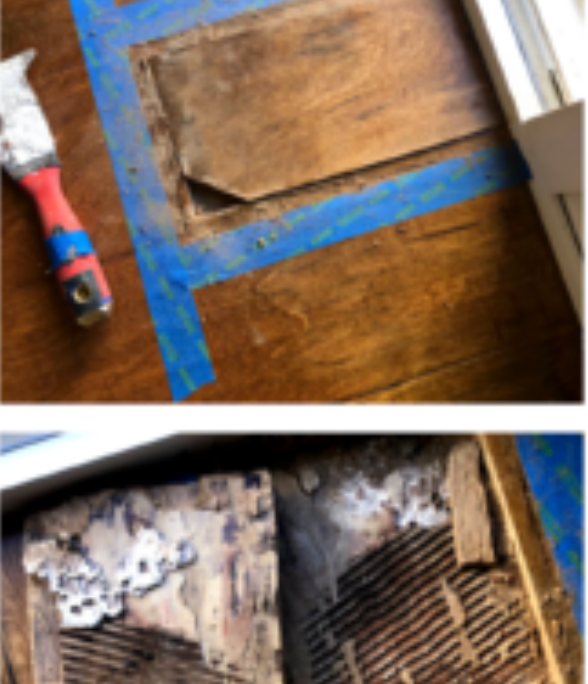
What you now see in the photo is a sample of a plank that was cut-out during the inspection in order to examine it and determine the root of the flooring issues.
(In these photos, clearly shows damage to the inside of the board caused by improper application of the adhesive)
PHOTO 2
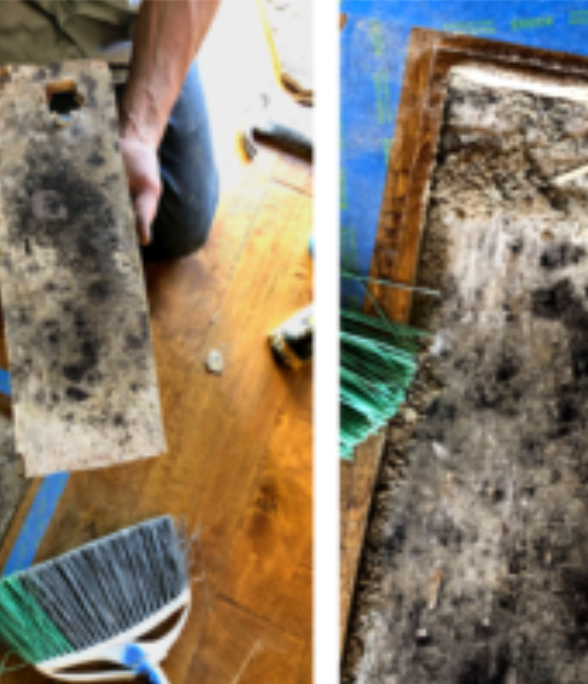
In the following photos, the inspector is holding a cut-out board that shows the presence of black mold, which is visible to the naked eye, resulting from the installation of the floor with the use of two-part adhesive in an unsuitable excessively, high-moisture, environment.
PHOTO 3
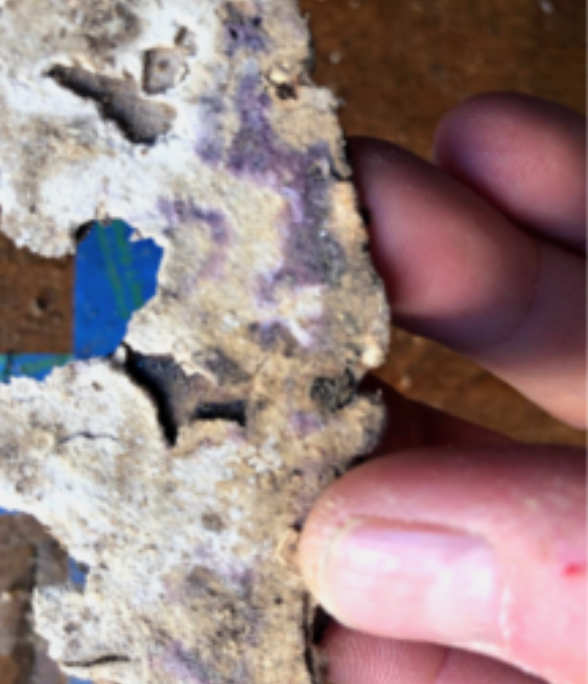
In this photo, the mold is a result of installing the flooring in improper conditions which is an unpleasant consequence of such a negligent performance by an unlicensed contractor.
PHOTO 4
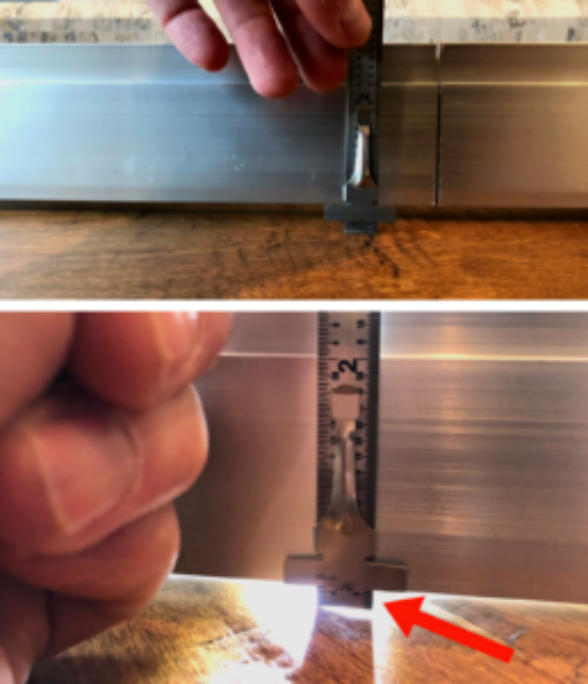
In this picture, you can see that there's a gap under the “metal straight-edge” which indicates that the flooring was installed over a subfloor that was NOT flat.
PHOTO 5
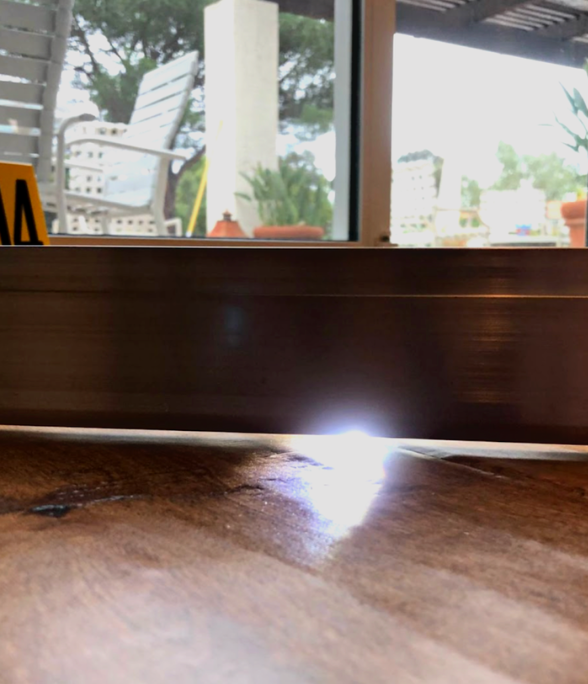
In this photo, you can see another “gap” which indicates that the flooring was installed over an unlevel substrate.
(A 10’ foot level with a flashlight shining behind it shows the extent of the out-of-flat nature of the flooring)
PHOTO 6
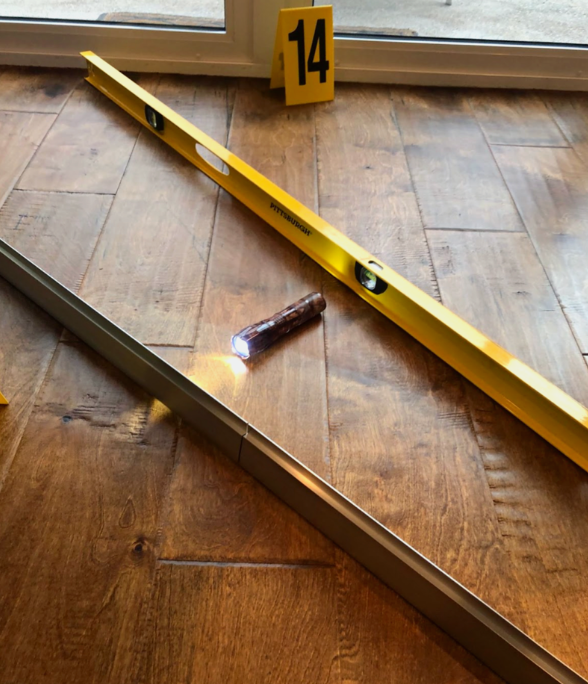
In this picture on an angle, it shows the same issue: There is a yellow level with a flashlight in between the photo and a 10’ foot level where the light can be clearly seen underneath it, showing the gap.
The failure of adhesive-bonded floors can be categorized in four basic ways.
Failures caused by:
- Abnormally high expansion of the wood flooring due to excessive environmental moisture, or, RH (Relative Humidity): The moisture content of the flooring is too dry for the environment in question.
- Excessively high levels of shrinkage of the wood flooring is due to excessive environmental heat, or, dryness, or even when the moisture content of the flooring is too high for the environmental conditions.
- Abnormal vertical pressure is caused by normal expansion where inadequate expansion spacing has NOT been provided
- Poor adhesion of the wood to adhesive, adhesive to the substrate, failure of adhesion of layers within the substrate, or, cohesion within a mineral base.
As bonded floors can fail due to the exposure of wood with excessive moisture levels, or, without any other contributing issues, the problem of excessive moisture should first be investigated.
Therefore, check if the individual flooring elements are “cupped” (edges of flooring are higher than the center of the floor-board), or warped in any way that will show any potential excess of environmental moisture.
Where individual flooring elements have “cupped” there will invariably be a problem with moisture. Flooring elements can be removed so moisture readings can be recorded in order to check for abnormally high moisture-content, or, abnormal variations between the upper and undersides of the flooring (Moisture readings of the sub-floor itself MUST also be checked).
In this case, no evidence of a moisture problem was found, although adhesively bonded floors may still fail due to inadequate, or, a complete lack of “expansion gaps”.
Other factors that affect the amount of expansion of a floor will include timber species, the size of the floor, and, the moisture content of the wood / RH of the environment.
Where floors expand and meet an obstruction such as a wall, structural support, or hearth, horizontal pressure builds up on the obstruction and horizontal and vertical pressure builds up on the floor. Eventually, the vertical pressure exceeds the adhesion strength resulting in the failure of adhesion, and the floors lifting or buckling, or flooring elements simply becoming loose.
You should ask yourself a question:
- Does the floor still have space for expansion where it meets obstructions such as walls, door frames, or structural supports for example?
Wider floors may require more expansion gaps where the flooring meets obstructions.
Failures can also come about when the moisture content of the flooring and the ambient conditions (temperature/humidity) are incorrectly matched:
The NWFA (National Wood Flooring Association) recommends that a 15-19% moisture-content for wood flooring is used in unheated environments, a 10-14% moisture-content should be used for intermittently heated environments, and a 9-11% moisture-content for continuous heating.
So, it’s time to consider:
What are the correct ambient conditions for an installation? ( above >30% and below <70% Relative Humidity)
- What was the moisture content of the flooring materials at the time of the installation?
- Were the materials acclimatized properly with a working AC/HVAC system?
When excessive environmental moisture levels or inadequate expansion gaps are not contributing to this problem, poor adhesion will most likely be found somewhere within the flooring installation.
In order to identify the problem more specifically, a loose floor-board can be removed and the point of the failure identified. It is important to note that any of the following points of failure can occur in combination with the previously mentioned causes.
Therefore it is necessary to assess these factors FIRST before identifying poor adhesion as a cause.
However, if you give preference to a licensed and proven Hardwood Flooring Contractor like Olde Tyme Floor Company (OTFC), you will never have to encounter the above problems, including ALL the aggravation and inconvenience that go along with such issues>
Trust Olde Tyme Floor!
We are licensed, bonded, and insured and have over 42+ years of experience in installing and restoring luxury hardwood floors!