
People Are Purchasing Garbage Floors In Their 3 Million Dollar Homes!
A homeowner purchased Engineered Hardwood Flooring and began to notice gaps, cupping, and cracking in EVERY floor-board even before the floors were installed throughout their house.
Why do you think these situations are occurring more and more frequently?
As experts in the hardwood flooring industry, this situation is constantly recurring to thousands of homeowners and it’s really haunting!
So, OTFC (Olde Tyme Floor Company) believes that it’s finally time to open people’s eyes to what is really happening out there, so maybe then, homeowners will think about how important it is to carefully check the quality of the flooring manufacturer before purchasing the hardwood flooring and having it installed in their luxury-dream homes.
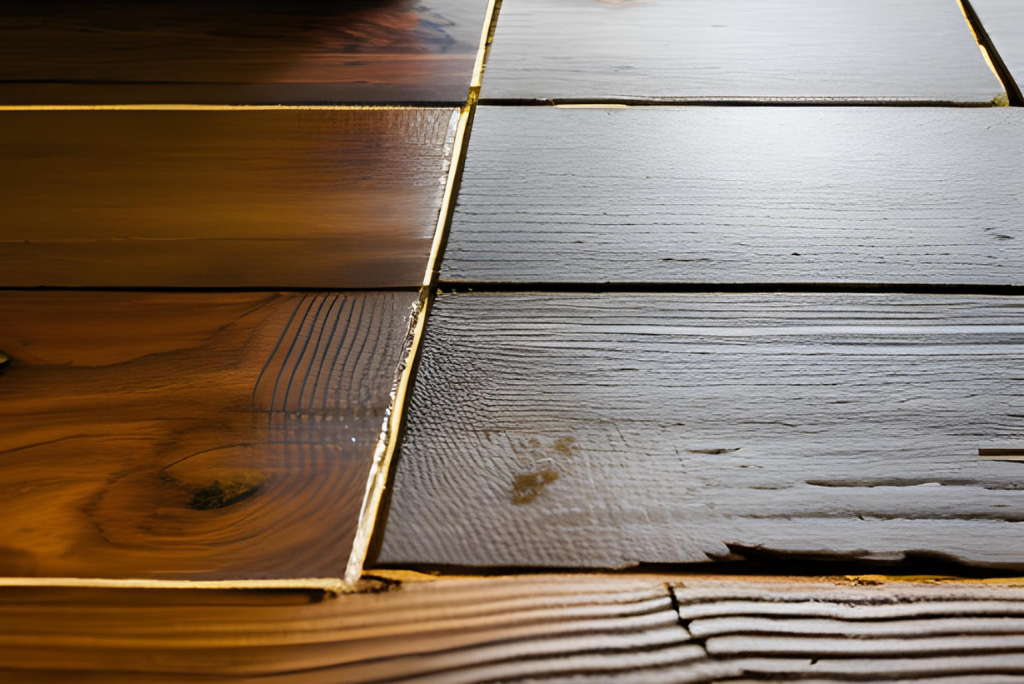
A homeowner purchased Engineered Hardwood Flooring and began to notice gaps, cupping, and cracking in EVERY floor-board even before the floors were installed throughout their house.
Why do you think these situations are occurring more and more frequently?
As experts in the hardwood flooring industry, this situation is constantly recurring to thousands of homeowners and it’s really haunting!
So, OTFC (Olde Tyme Floor Company) believes that it’s finally time to open people’s eyes to what is really happening out there, so maybe then, homeowners will think about how important it is to carefully check the quality of the flooring manufacturer before purchasing the hardwood flooring and having it installed in their luxury-dream homes.
We can all agree that it’s not our business in telling you that it’s a big investment when a homeowner decides to purchase and install hardwood flooring in their house…
But even though people invest huge amounts of money, often they do NOT pay attention to such trifles as the place of production of the floor, indicated in small print on the packaging.
Instead of being attentive to every crucial detail regarding the make-up of the plywood core, for instance (if we are talking about engineered wood floors), the homeowner only sees a beautiful picture of the flooring on the retailer’s website and instantly wants to purchase the product.
However, in most cases, everything that is hidden behind the beautiful pictures of samples that you see on their modern-designed websites is a blatant lie and full of deceit.
Most consumers are led to believe that they’re ordering European-made, engineered hardwood flooring, then find out they’re made somewhere in Asia.
Why is this?
Well, this is because of all the misleading marketing that has fancy names and reads something like: “Exclusive French Collection Engineered Hardwood Flooring” (If you read this name you would never ever realize that it’s made in Vietnam, China, or Malaysia.
But it is!
These manufacturers from China or Vietnam produce their poor quality plywood in appalling conditions, using cheap labor, ancient equipment, and absolutely no accepted standards of manufacturing, and in the end, they sell it here in the US for millions of dollars, whitewashing Americans on crazy sums!
This is exactly what happened to the homeowner, and we are convinced that you would be furious and would NEVER again neglect the choice of the manufacturer when you see the details and photos from this inspection case.
So let’s dive in right now!
The homeowner stated that there were gaps, cupping, and cracking on EVERY floor-board, which was to be installed on the second floor, and that they were purchased but not yet installed.
(It should be noted that the acclimatization, including the moisture content and air temperature, was proactively kept between 68F and 72F degrees in the home where the uninstalled flooring material was kept at all times.
As we mentioned above, this product was not fully installed due to the defects that were found in the upstairs installation, and, the remaining uninstalled boxes of the product.
CASE 1
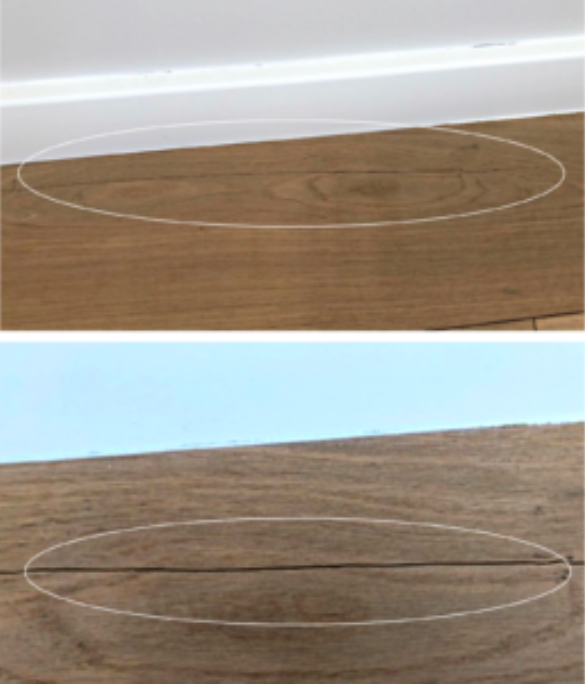
This is a photo that has a large crack visible from a standing position on the surface of this floor-baord was installed on the second floor.
CASE 2
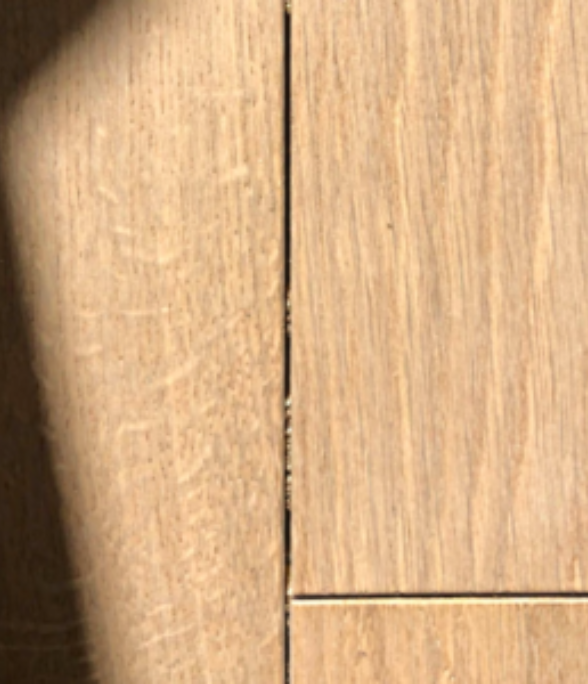
In this photo, you can now see a close-up photo of the gap/separation in the flooring surface on the installed second floor.
It’s clearly visible how the line of separation is running throughout the whole length of the floorboard.
CASE 3
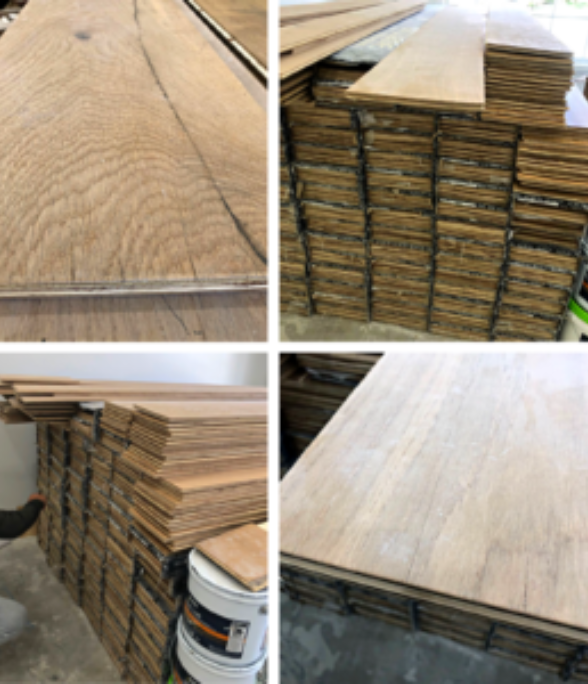
In these photos, it shows that the flooring inspector opened many cartons of flooring and discovered large vertical cracks, through the entire surface, including the main part of the wood.
Other photos show the stacking and acclimation process and how many of the floor-boards were cracked and defective in this group. As well, you can see the out-of-flat condition of the flooring planks right out of the box.
CASE 4
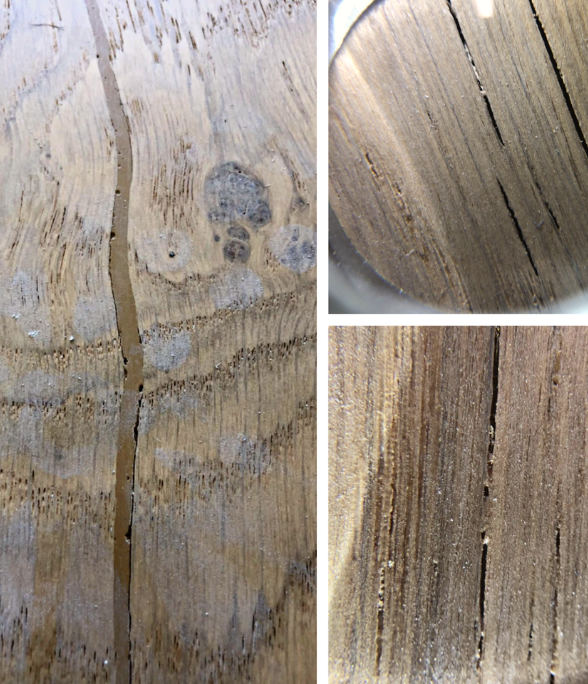
Take a look at this large vertical, wide crack and the cracks under a magnifying glass that was used by the inspector at a different location on the sample.
Now you can imagine how much money was wasted on this not yet installed engineered wood flooring, and, on the part of a catastrophic floor that, unfortunately, was installed on the second floor.
CASE 5
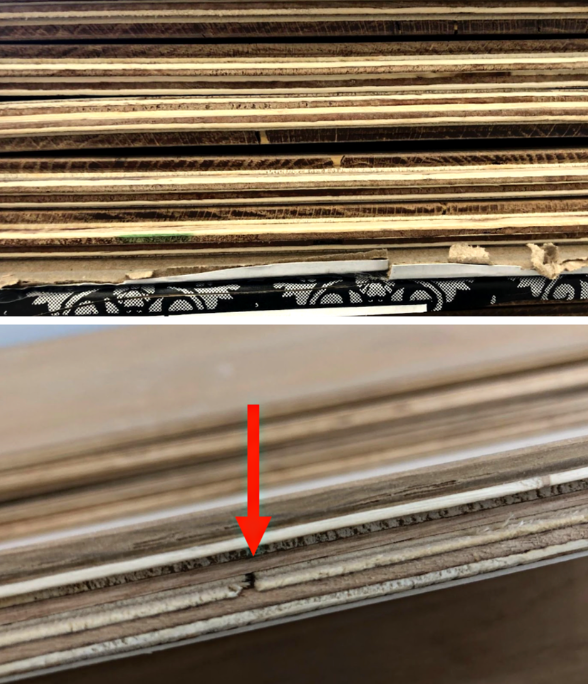
This photo shows damage to the internal structure of the floor sample.
Take a look at the structure of the plywood board of this engineered floor: it absolutely does not meet the standards of the NWFA (National Wood Floor Association)
As we already explained, these hardwood floors were produced in Vietnam where no one thinks about quality and trying to save as much money as possible on the prime cost of the product and then selling it to the US with a simply unimaginable markup of the final price.
CASE 6
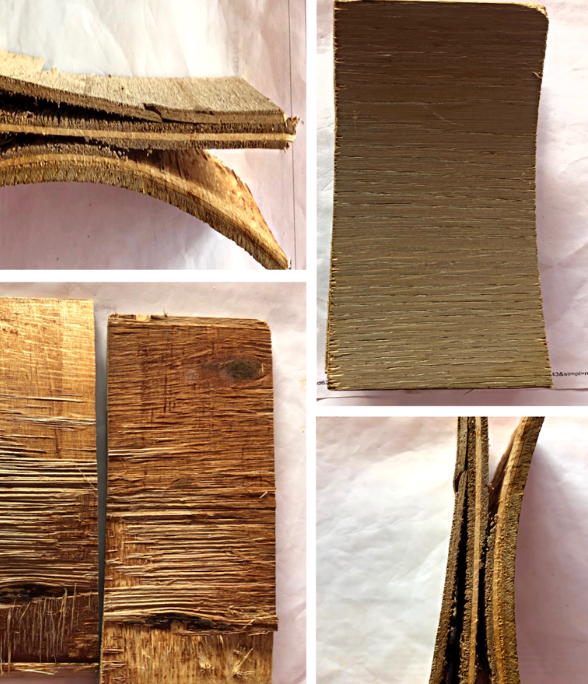
Not surprisingly, this sample of flooring failed the boiling test. In these photos, you can see what happened with the “rapid-age boiling test sample” which shows the cupping, delamination, and degradation of the bond between the layers. (This shows a very defective product with this level of degradation)
In order to better understand what a “boiling test” is, you can follow this link to the YouTube video
Summarizing, all of the defects found were from a manufacturing standpoint. The cracks, gaps, and cupping were due to the faulty manufacturing of the product.
This product was manufactured in Vietnam, and their process of manufacturing can often lead to these kinds of defects.
Using this case as an example, we can conclude that there are dozens of manufacturers who sell their Asian wood floors here in the US trying to scam homeowners by hiding the floor’s real origin.
Of course, this inspection case was full of various examples of flooring issues that occur as a result of the poor manufacturing process.
However, OTFC still decided to supplement this article with five of the most common manufacturing defects for hardwood floors:
Improper or Uneven Drying Time
One of the most important and critical steps for hardwood flooring material is the kiln drying process. The wood MUST properly dry so that the moisture can be removed from all the fibers. Sometimes, it can take weeks for green lumber to go through the drying process. If it is not done correctly, there can be issues with the wood flooring down the road.
Incorrect Grading: Lumber grades have national and international standards for certain qualities, like color, appearance, size of knots, and more. Sometimes the manufacturer can incorrectly grade the flooring material so that the installer and the customer don’t get exactly what they ordered.
Mis-milled Flooring: When wood is milled into flooring, the exact specifications must be perfect including the “tongue and grooves” which MUST be line-up perfectly (Milling defects can lead to long-term flooring problems for both business owners and homeowners)
Sticker Stains: Sticker stains, or sticker shadows, are discolored parts of the wood where a sticker was placed during the drying process. It appears as a dark area in the shape of the sticker and can be especially noticeable after the wood has been finished.
Flaking and Splintering: When it comes to the finish on a wood floor, they are either factory-finished, or, are finished after the installation process. Either way, the flooring should be covered with a durable finish, however, there are times when the finish will flake or chip away, exposing the wood underneath. “Splintering” occurs when moisture causes the board to swell, so an improperly finished edge is the weakest part, and may splinter.
To avoid these unpleasant issues with engineered hardwood floors (listed above), OTFC (Olde Tyme Floor Company) advises you to select materials very carefully and check the manufacturer several times before purchasing the materials.
Nevertheless, it’s always better to entrust every step from the selection of materials to installation and maintenance to professionals like us!