
“I Want ALL the Wood Floors to be Replaced Throughout my Entire Home!”
These are bold words, aren't they? What was the reason for such a statement?
Well, our homeowner has a penthouse apartment with custom hardwood flooring, including several custom designs throughout most of their unit.
Unfortunately, the property suffered water-damage and the flood affected an area of wood flooring adjacent to the bathroom. The homeowner hired a flood remediation company to thoroughly dry-out the flooring and actually saved the flooring.
However, the homeowner claimed that the flooring needed to be replaced due to a water issue in the Master Bathroom.
In order to decide what action to take on the flood-damaged wood floor, we have to delve into the details of this case.
CASE 1
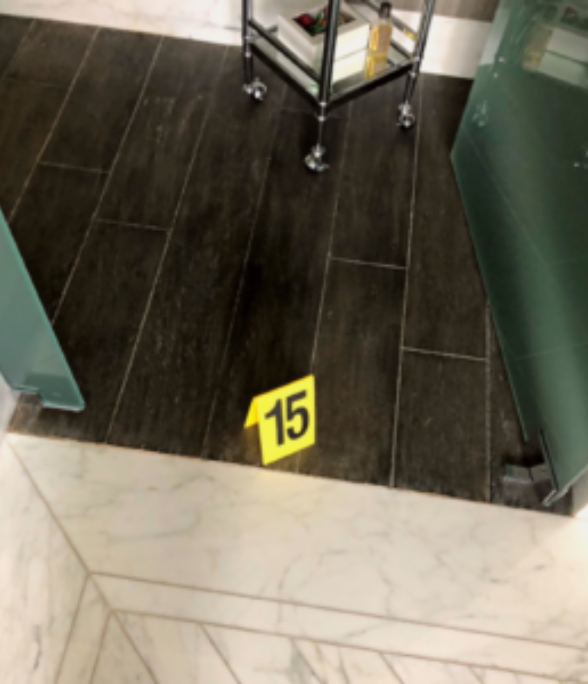
The first photo shows us that the wood flooring was directly affected by the water leakage.
The water then flowed from the marble floors onto the wood flooring, soaking the wood.
After the flood remediation service, measurements showed a moderate moisture content of 13.1%.
CASE 2
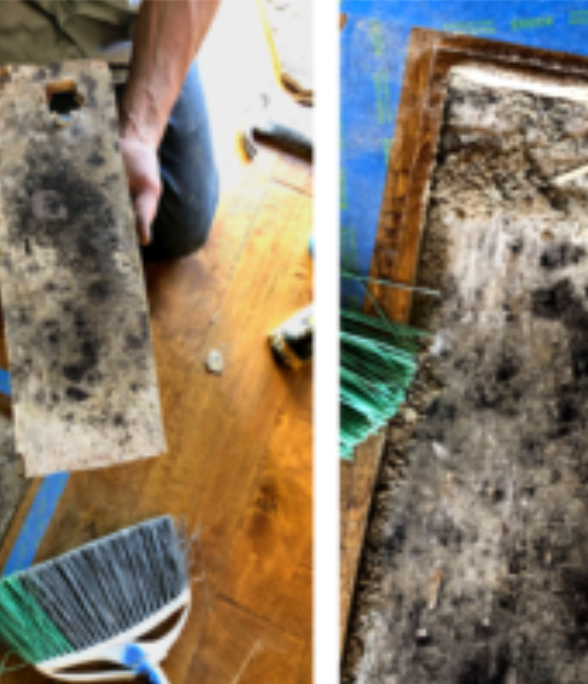
This photo shows where water stained the floor and was addressed by a professional flooring contractor.
DOES this mean that the removal and replacement of ALL the hardwood flooring was absolutely necessary in this case?
CASE 3
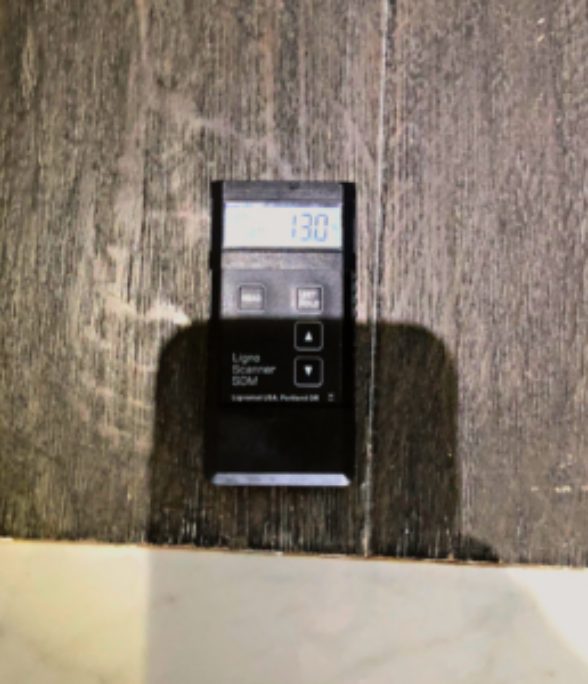
In this photo, the Ligno Scanner reading was taken in proximity to the bathtub.
It displays the highest moisture reading found and should be noted that NO active water leak was detected (this moisture level of 13% is within NWFA standards of “normal”)
CASE 4
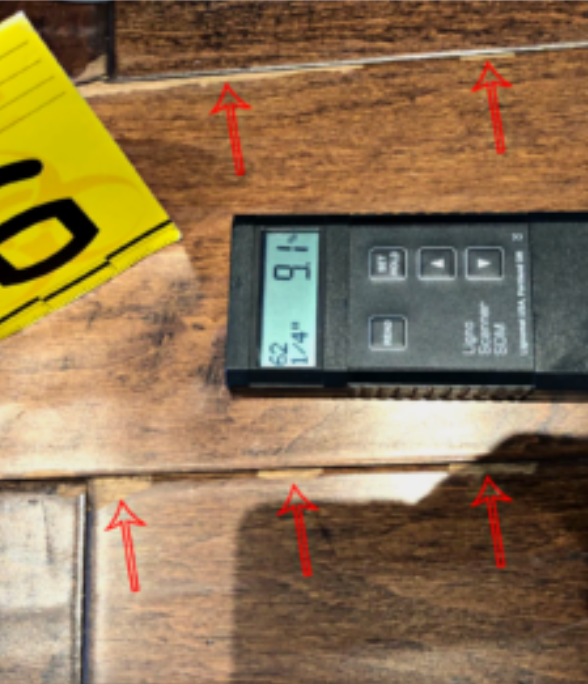
This photo shows where water stained the floor and was addressed by a professional flooring contractor.
DOES this mean that the removal and replacement of ALL the hardwood flooring was absolutely necessary in this case?
CASE 5
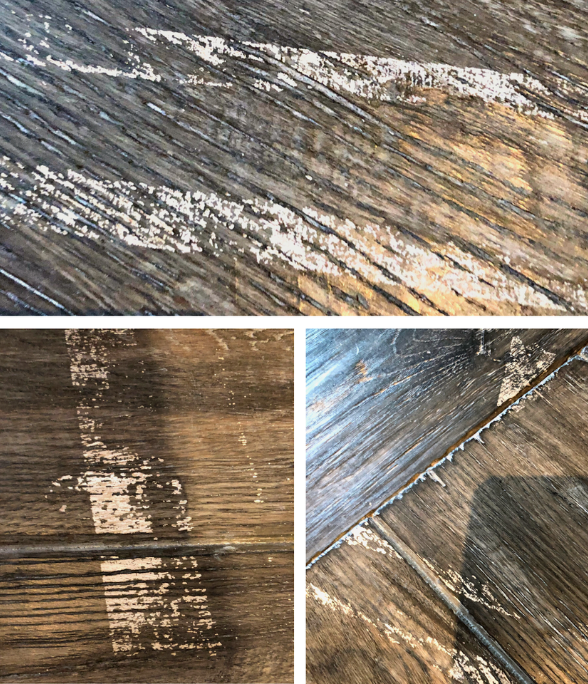
In this photo, it’s visibly clear that the flood remediation company used strong tape on the floor during the remediation stage which was not formulated in keeping the floor surface from being damaged.
When the remediation company removed the tape, it removed layers of the finish, including the stain, which is showing the raw wood, which can be easily corrected.
CASE 6
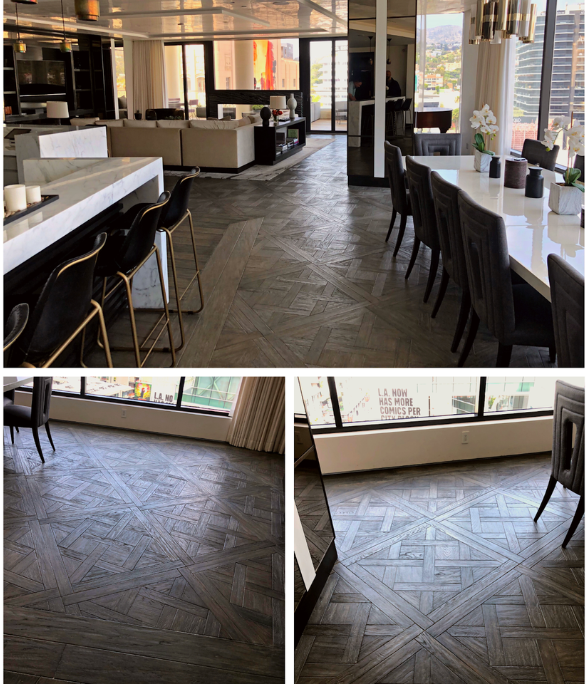
These photos depict the living room and dining room of the residence.
All the flooring is custom hardwood panels,each measuring 36” x 36” inches.
*Note: There are No issues in this part of the home with water-damage, OR, any other kind of damage.
(Per NWFA standards, this flooring does NOT need to be removed and replaced)
To sum-up everything and create a clear understanding of this case:
The flooding occurred from the bathtub in the master bathroom which leaked onto the hardwood flooring directly adjacent to this bathroom.
The remediation company caused other damage which can be repaired by a professional Hardwood Flooring Contractor that specializes in restoration.
Based on the findings of this report, Olde Tyme Floor Company suggested that the majority of the custom hardwood flooring can be resurfaced and restored as it was unaffected by the flooding from the master bathroom.
Additionally, the NWFA flooring inspector found NO evidence of elevated moisture in the flooring which would NOT be potentially problematic for the homeowner.
Olde Tyme Floor’s recommendation is that in the areas where the flooring was damaged, the floors COULD BE resurfaced & refinished to eliminate the minor, localized stains that resulted from the flooding.
OTFC also recommended that the areas of the flooring subjected to damage from the tape removal during the flood remediation process could also be eliminated by refinishing as well.
(The NWFA guidelines state that a floor DOES NOT need to be fully removed if it can be avoided, so this floor can be restored without replacing it in totality)
Now it's time to teach you how to figure out on your own what to do with your hardwood floor after a flood.
Imagine yourself as the homeowner from today's inspection case…
The worst happened: you’ve come home to discover water-damage due to a burst pipe, a leaky sink, or an overflowing toilet.
As you’re the homeowner now, it’s now time to figure out whether to remove and replace ALL the floors throughout the entire home or, maybe it’s possible to simply repair the affected boards.
The answer to this question depends on a variety of factors.
We know that water-damaged hardwood floors are a huge disruption to your life, so, let’s quickly jump into the aspects that point either to a new floor installation or easy water-damage repairs.
Ask yourself the following question and take action depending on the answers.
Question 1: How long ago did it happen?
The first thing you need to ascertain is how long ago the flooding/water damage occurred. If the water made contact within the past few hours, you may be able to clean-up the spill with minimal effects on your floors.
However, if you were out of town and the water had more than a couple of hours to sit, perhaps even days, your floors are most likely in trouble. (The longer the water sits, the more damage it can do, AND, the more likely it is that you’ll need to entirely replace your hardwood flooring).
If you’re not exactly sure when the damage occurred, here are some signs that the water has had too much time to wreak havoc:
- The floors are stained and discolored;
- Some boards are buckling/cupping;
- Nails are popping out of lifted boards;
- Mold has begun to grow.
The first indication that the floors need to be replaced is usually their shape.
Although the boards might seem dry, if a “hump” forms, or, the floor starts to “cup”, you’re likely looking at a situation that’s beyond simple repairs.
Question 2: How bad is the visible damage?
As we talked about it in question #1, visible damage can appear on your floors when the water has had enough time to sit and and take effect. Even if the problem was caused by “clean” water, you need to watch out for these major signs of permanent floor damage:
Crowning
When boards are forced together by built-up moisture, it results in “crowning.” You will likely see boards sticking out or shrinking. You’ll even see the boards raised up in the center, forming a sort of hill, or mound. (This is a serious problem area, and in most cases, the floors will need to be replaced to deal with the cupping)
Buckling
In rare instances, the water damage is so severe that the individual boards of the floor will stick out. This is the most extreme form of physical damage due to water, which means your hardwood floors will almost certainly need to be completely replaced.
Staining
If you notice that your water-damaged floors are beginning to lose their color, you’re likely dealing with staining. You may see whitish circles, which indicate mild damage that could be addressed with repairs and refinishing.
However, if you see dark black stains, the water has infiltrated the floorboards, and you’ll either need to conduct major repairs, or, completely remove the flooring altogether.
Cupping
Lastly, “cupping”: occurs when your hardwood floors expand and become uneven on the edges. It’s essentially the opposite of crowning. This can cause serious problems going forward, so your best choice is most likely to have new floors installed before things get worse.
Question 3: Are You in a Hurry?
The next thing you need to consider is your timeline. If you have plenty of time to spend repairing your wood floor’s water damage, then you might not need to schedule a new hardwood flooring installation. However, if you have children and pets running around frequently, you’ll likely want to fix them much sooner.
Question 4: Are you ready for a fresh start?
Let’s say you deem your floors repairable. The last thing you need to ask yourself is, “Do I really want to repair my floors? Or would I rather just replace them?”
In order to repair water-damaged areas, you’ll still need to go through a long process, including plenty of expenses. Perhaps this is actually a better opportunity to start with totally new floors that aren’t scratched, out-of-date, and damaged.
Many homeowners use water damage as a chance to install new flooring that is better protected against future accidents.
If this kind of redecorating opportunity sounds appealing, please call Olde Tyme Floor Company to learn what your options are.
To sum it all up, our advice as flooring professionals is to determine how serious the water damage is, then go from there. If the damage is extensive, you’ll likely save time and money by just replacing everything, rather than picking a few spots to repair.
CALL: +1 (818) 469-2267 today to speak to the President of OTF, Scott Schneider.
(Please don’t forget to follow us on social media platforms so you can read ALL our company’s news)
We look forward to hearing from you soon!