
What was the real cause of deep cracks in such luxury and expensive floor covering as Solid Euro French Oak?
FYI (For Your Information): The average cost of this type of hardwood flooring varies from $5 to $10 per square foot (this price does not include installation).
Therefore, you can imagine what a vast amount of money the homeowner invested in their flooring, taking into account the fact that there are approximately 2,000’ square feet of flooring that was installed in the house.
You can imagine the homeowner’s deep disappointment when after (1) year of the installation, they started noticing cracks and checks on the face of the flooring.
Olde Tyme Floor knows how passionate you are about all the flooring issue stories we bring to you. So, today we’re inviting you to review this case together in order to find the root cause of such severe damage.
But before we get started, we would like to tell you one crucial aspect that should not be missed! When the homeowner contacted the retailer for an explanation of what caused the damage, the retailer stated low humidity was the cause for the cracking and checking of the floor. (Please remember this statement as we begin our inspection).
Below, you will see photos and descriptions of the damaged flooring.
Ready….Let’s dive in!
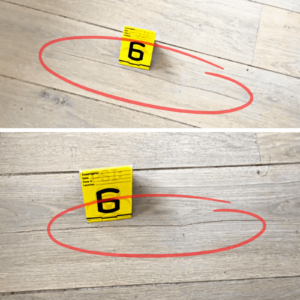
These photos clearly show the crack on the Oak flooring.
(The yellow teepee-tag was set next to the crack that appeared in the flooring after the installation was performed)
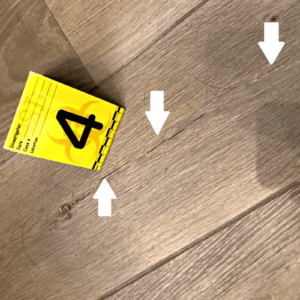
This Inspection photo shows (1) of the “surface-checks” from a closer vantage.
*The NWFA (National Wood Flooring Association) defines “surface-checks” as “separations in the wood fibers that usually occur in, or, adjacent to, the wood rays, on the surfaces of plainsawn (flatsawn) floor-boards. These separations occur during the early phases of the drying process where the external and internal stresses cause the wood to tear itself apart”.
This photo shows “end-checking” with nail holes indicating that the installer attempted to stabilize the plank.
“End-Checks” are defined by the NWFA as similar to “surface-checks”, only they occur “on the ends of the planks rather than on the face of the flooring. These separations occur due to the normal movement of moisture along the length of the boards, where the ends of the boards dry more rapidly, leading to stress fractures on the ends of the boards”.

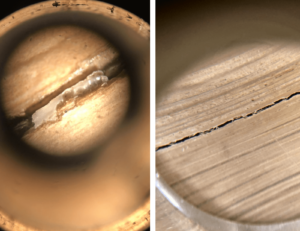
In these inspection photos, you can see (1) of the cracks/checks under a magnifying lens (50X) and at (8X). The magnification shows wood filler inside the crevice, as well as in the finish within the crack.
This indicates that the crack existed BEFORE the floor was finished.
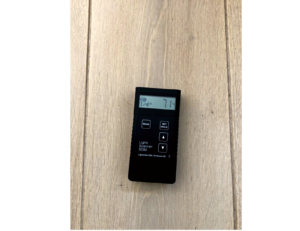
This is a photo of a pinless “Ligno Scanner” which is used to measure the moisture-content of the floors.
Please note that the average moisture content of 13 measurements was 7.7%, which is completely within the normal range.
That being stated, our inspection has come to an end and we will draw the correct conclusion based on the assessed information.
In conclusion, we need to sum-up ALL the facts again:
In January, the flooring was installed at the homeowner’s residence.
Within (1) year, cracks and checks began to appear in the flooring.
The homeowner had approximately 2,000’ sq. ft. of hardwood flooring installed on the first floor.
The retailer used “low humidity” as an excuse for the cracking and checking of the floor.
According to our observations, humidity levels were approximately 40%, which falls in the normal range of indoor humidity recommendations (There were a few, small, localized areas that had a moisture content which were NOT in the recommended range)
WHAT EXACTLY CAUSED THE DAMAGE?
The examination of the cracks showed evidence of wood-putty which protruded-out after the expansion of the checks. This was caused by using poor-quality wood putty to finish the floors. The cracks were observed at 8x and 50x magnification. Evidence of finish material was interwoven throughout the cracks. Finished materials can be present in a crack ONLY if it was applied to the flooring with pre-existing cracks.
In conclusion, the finished materials within the cracks indicate that they existed BEFORE the finish was applied and that the cracks were NOT caused by overly dry conditions, as they existed before the flooring was installed.
This is a factory DEFECT, including an error by the installer for not filling the cracks sufficiently with a high-quality wood filler.
Now, you can clearly understand the origin of these cracks.
Considering the fact that the cause of the damages was a factory defect, Olde Tyme Floor Company prepared a small guide:
“What can you do to ensure the flooring you want is, in fact, the flooring you get?”
First and foremost, ALWAYS ask questions! Make sure that the company you’re going to purchase the flooring from sells the exact products exclusively from the manufacturer that it claims to on their website, and, in conversations with you!
If you do not like the answers, head for the door!
Secondly, check prices.
Companies offering low prices for products manufactured in China are not the best businesses to do business with!
And FINALLY, get testimonials!
When you've found a company that seems legit, it's ALWAYS a great idea to read some of their other customer’s reviews for opinions. Are they happy with what they received?
We hope that you enjoyed the role of playing “inspector” with OTFC today.
Please take note of all the tips that we’ve provided you, including these problems, so this will NEVER happen to you!
We will take care of everything, including listening to ALL your wishes and never allowing any trouble to appear after the work has been completed.
Trust OTFC!
Olde Tyme Floor Company has developed an award-winning reputation for installing and restoring luxury hardwood floors!